


We supply a raw material, not a health promise. This page sets out what statements about our essential oils rest on, where the research stands, and how we separate a supportable property from an unlawful health claim. This openness is part of the quality for us: saying exactly what is in the oil and what is not gives formulators a basis they can rely on. For the detail, the studies are laid out in our review of the evidence.
The evidence at a glance
The table below orders the strongest work on Boswellia frereana and Boswellia carterii. The decisive column is Material: it shows whether the distilled oil or a resin extract was studied. That alone settles the question of what transfers to our oil.
| Study | Material | Key finding | Type |
|---|---|---|---|
| Blain 2010 | B. frereana, resin extract | Inhibits cartilage breakdown; lowers MMP-9, MMP-13, nitrite, PGE2 and COX-2; main constituent epi-lupeol | in vitro |
| Obiștioiu 2023 | Boswellia oil blend (incl. carteri, frereana) | Antioxidant, antimicrobial, anti-inflammatory (markers and molecular docking) | in vitro |
| Frank 2009 | B. carterii, essential oil | Selective cytotoxicity against J82 bladder cancer cells, sparing normal urothelial cells | in vitro |
| Han 2017 | B. carterii, essential oil | Anti-proliferative in dermal fibroblasts; lowers collagen III, IP-10, ICAM-1 | in vitro |
| Chevrier 2005 | B. carterii, extract | Immunomodulation: inhibits TH1, promotes TH2 cytokines | in vitro |
| Mohamed 2025 | B. carterii, oil plus chitosan nano | Reduces breast cancer cell viability; alpha-pinene 35.8 percent | in vitro and in vivo |
| Pedretti 2010 | Boswellic acids from B. serrata, 0.5 percent cream | Smoother skin, fewer fine lines, better elasticity, less sebum | RCT (human) |
Two notes on the table: Pedretti 2010 concerns boswellic acids from B. serrata, not distilled oil. And Han 2017 and Mohamed 2025 are industry-affiliated and warrant cautious reading.
Distillate is not boswellic acid
In the market, almost every health-related frankincense claim is justified with boswellic acids. But these are non-volatile triterpenic acids and remain in the resin during water-and-steam distillation. Because transparency matters to us, this is exactly where we separate cleanly: our distilled essential oil consists of the volatile terpenes, dominated in carterii by alpha-pinene. That molecule gives the oil its fresh, pine-like top note, and the literature describes it as an antioxidant. The real strength of the distillate sits in these light, aromatic terpenes. That leads to a clear separation:
- Transferable to the oil: antioxidant and antimicrobial properties of the terpenes, and every study that actually tested the oil, namely Frank 2009, Han 2017, Mohamed 2025 and Obiștioiu 2023.
- Not transferable one to one: the large boswellic-acid literature on arthritis and inflammation and the skin-aging study Pedretti 2010, since they concern resin and CO2 extracts or B. serrata.
- The frereana special case: the anti-inflammatory finding in Blain 2010 comes from a resin extract, and its main constituent epi-lupeol is barely volatile. How much of it carries into a distillate depends on the method and is not documented. We check this by GC/MS and communicate it honestly.
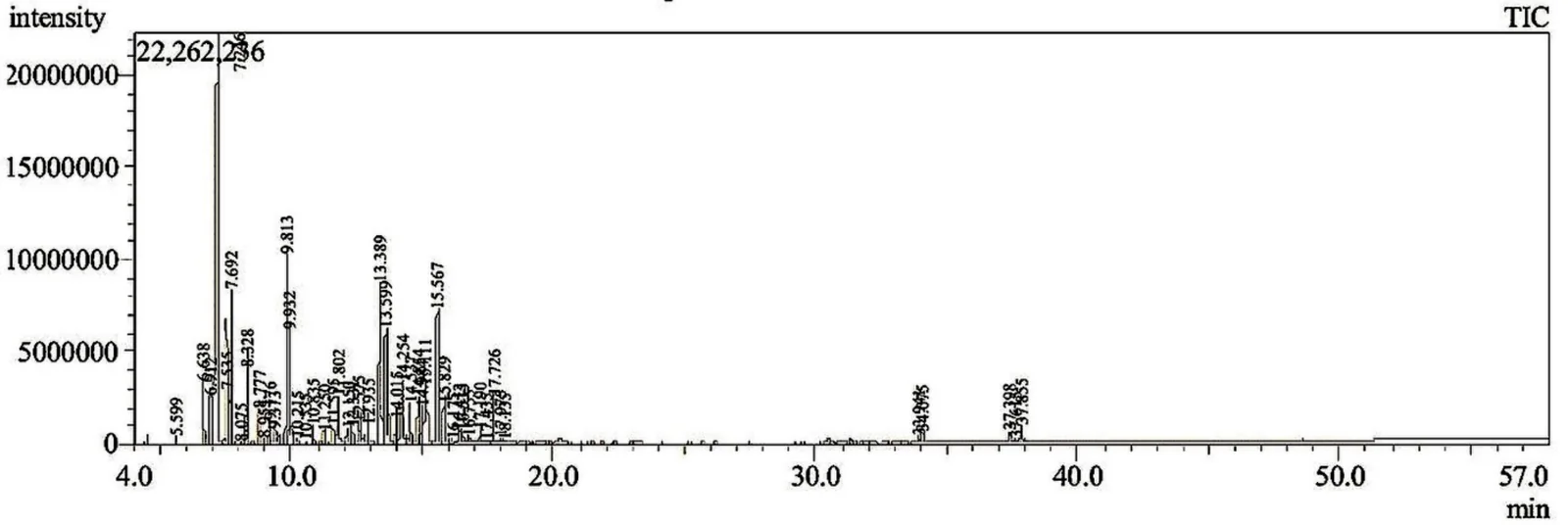
The most abundant volatile constituents of this oil from the GC/MS analysis:
| Constituent | Share |
|---|---|
| alpha-pinene | 35.81 % |
| sabinol | 6.47 % |
| trans-verbenol | 5.55 % |
| m-cymene | 5.32 % |
Data: Mohamed et al. (2025), Table 2 (alpha-pinene = peak 4).
What we say, and what we do not
We keep our language to what can be supported:
- We describe our oils through origin, botany and constituents according to published analyses.
- We name documented properties of the terpenes, such as the antioxidant properties described in the literature for alpha-pinene-rich Boswellia oils, factually and with a source.
- We present preclinical findings for what they are: signals from cell and animal models, not an established benefit in humans.
- We make no medical or health-related claims, no health promise, and no statements about hormones or disease.
This line follows the spirit of the EU Cosmetics Regulation (EC) No 1223/2009 and the Claims Regulation (EU) No 655/2013: lawful, truthful, evidenced, honest, fair. A health promise would turn a cosmetic into an unauthorised medicinal product. We avoid that strictly.
A raw material for formulators, not an end-consumer claim
As a B2B supplier of essential oils, we communicate primarily on a technical level to formulators. In a raw-material or safety data sheet we present documented properties with a source, factually, for example: the literature describes antioxidant properties for alpha-pinene-rich Boswellia oils. That is different from a promotional statement on a cosmetic label, which falls under the Claims Regulation. Responsibility for the final claim rests with the company placing the product on the market, our customer. We supply the solid data basis, not the promise.
The warmth is in the origin
The scientific part above is deliberately sober. The closeness to our oil comes from elsewhere: from the limestone cliffs of the Cal Madow in Sanaag, where the resin has been wild-harvested by hand and non-destructively for generations, and from the families who know these trees, including our own. We buy directly from them, with no middlemen. This origin we can name and document, and it is the reason we stay so precise about everything else.
Honest notes
- Most of the evidence is preclinical, meaning cell and animal models. Such data does not support any health-related claim on the product.
- Observe allergen labelling under Regulation (EU) 2023/1545; check REACH and CLP for the oil as a substance or mixture; keep the CITES status of Boswellia in view.
- The sources listed can be checked independently via the DOI below.
Sources
- 01 Blain EJ, Ali AY, Duance VC (2010). Boswellia frereana suppresses cytokine-induced matrix metalloproteinase expression in articular cartilage. Phytother Res. 24(6):905-912.
- 02 Frank MB, Yang Q, Osban J, et al. (2009). Frankincense oil derived from Boswellia carteri induces tumor cell specific cytotoxicity. BMC Complement Altern Med. 9:6.
- 03 Han X, Rodriguez D, Parker TL (2017). Biological activities of frankincense essential oil in human dermal fibroblasts. Biochim Open. 4:31-35.
- 04 Obiștioiu D, Hulea A, Cocan I, et al. (2023). Boswellia essential oil: natural antioxidant as an effective antimicrobial and anti-inflammatory agent. Antioxidants (Basel). 12(10):1807.
- 05 Chevrier MR, Ryan AE, Lee DY, et al. (2005). Boswellia carterii extract inhibits TH1 cytokines and promotes TH2 cytokines in vitro. Clin Diagn Lab Immunol. 12(5):575-580.
- 06 Mohamed N, Ismail H, Nasr GM, et al. (2025). Anti-tumor potential of frankincense essential oil and its nano-formulation in breast cancer. Pharmaceutics. 17(4):426.
- 07 Pedretti A, Capezzera R, Zane C, et al. (2010). Effects of topical boswellic acid on photo and age-damaged skin: a double-blind, randomized, split-face study. Planta Med. 76(6):555-560.
This article describes botany, constituents (per published phytochemical analyses), origin and tradition. It makes no medical or health claims.
© Farah Duale

